


This still can be a beautiful world, if we decide together to make it so
I am a Southern white working-class woman, and I was a worried child.
For all my young life, I’d been told that it was possible that God would send me to hell when I died. The first time I embarrassed my parents was when I insisted, at age 10, on being baptized even though I had already been baptized at age 6. I wanted to do it again because I was tormented with worry that I hadn’t believed correctly the first time. After I was baptized the second time I still wasn’t sure but said nothing about it.
When I was eleven and in the sixth grade, I found a child’s biography of Harriet Tubman in my school’s library. I think that the book may have been placed in the wrong school. It was 1959 in segregated Alabama, and it may have been intended for a Black school but somehow got mis-routed. I read it and even gave a book report on it, but though the violence against the child Harriet shocked me to my core, the meaning and import of her life escaped me. I kept waiting for the writer to explain why it was wrong for Harriet Tubman to have gone against the authorities of her day. No such explanation was given, and I was left with the impossible idea that those authorities, which I intuited were the same ones still in place in my world, could not be trusted. (more…)
Over the Mountain
It was a muggy Sunday in September 1963. I was ten years old, standing in the kitchen when the phone rang. It was Ethel, whom we called our “maid.” I don’t remember her last name. She was a domestic worker who cleaned our house and often took care of us. She called my parents, “Mr. and Mrs. Schaffer,” but she was only addressed by her first name. We lived in the all-white neighborhood of Mountain Brook, Alabama.
My father took the phone from me. Ethel was wailing and screaming. I knew something traumatic had happened, and I was terrified. My father tried to get Ethel to tell him what happened. After an hour or so, he got off the phone. He turned to me and said that Ethel’s daughter’s best friend, Denise*, had been murdered along with other children. A bomb had exploded at Ethel’s church. He said, “We’re next.” (more…)
The White League and My Great-Grandfather
This has happened before—that sick feeling deep in my interior where words do not exist to describe it. Usually, it was caused by something like seeing a bill of sale from one of my enslaver relatives about selling a child. Or buying one. This time it hits closer because I am named for the man about whom I have just learned participated in the White League. The man is my great-grandfather, and he is part of me. In today’s language the White League would be described as a white supremacist quasi-military terrorist organization. It started in 1874 in the South to intimidate freedmen into not voting and prevent the then Republican Party from getting power.
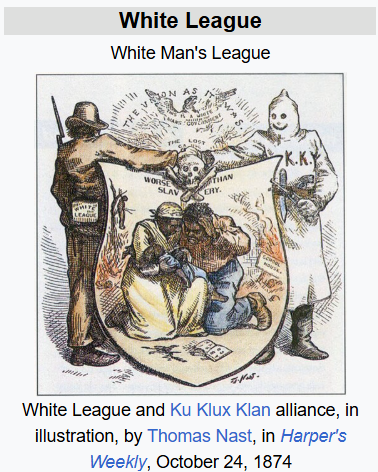 What a shock this morning, Christmas only two days past, to get an email from Ancestry.com with a “hint” about William Marshall Richardson—a newspaper clipping from 1874 about the formation of the white supremacist group in the Louisiana Parish, New Iberia, where he lived. His name was in the list of original members in the article. Articles about the Grande Assemblée de la Ligue Blanche were also printed in Louisiana’s French newspapers.
I thought I knew a lot about my great-grandfather. This latest revelation shocked me. I had heard of the White League but knew almost nothing about it until now. (more…)
Birmingham: Trauma and Sorrow
I am a little older than most of this group, Kids in Birmingham 1963. I moved to Birmingham from a suburb of New York City in 1946 at the age of five. My parents had bought a house on Southside and did not have a car. I was soon taking a city bus downtown by myself for various reasons. On the buses, I noticed the disparity between what white people had to do to ride the bus and what Black people had to do. I learned I was white from riding the buses. They had movable signs inserted in bars across the backs of the seats that said White on one side and Colored on the other, and I knew I was to sit in the white section. I had known about the maternal side of my family being enslavers for as long as I can remember, it always troubled me. After graduating from Ramsay High School and attending St. John’s College in Annapolis, Maryland, for one year, my then-husband and I were married in 1960 in the Unitarian Church. He and his family had been attending the church since the late 1950s. We along with other members of the church soon became involved with the African Americans’ brave struggle for their civil rights.
The year 1963 is seared into everyone’s memory. (more…)
Birmingham’s Black radio DJs were like little gods in our lives
In this segment of an expansive oral history she gave in October 2025, Ann speaks of the Black radio stations that broadcast some of her father’s sermons and of the celebrity DJs, who were “like little gods in our lives.” Peering from an upstairs window of the parsonage, Ann could see two Black radio stations, including WENN, where renowned DJ Paul “Tall Paul” White would later give a shoutout to Ann’s brother Luke Beard, who had been his classmate at Parker High.