Marcia E. Herman-Giddens
Marcia Edwina Herman-Giddens was born in Washington, DC, to a Pennsylvania father and a south Florida mother. In 1947, the family moved to Birmingham, Alabama, arriving when the first bombings of African American establishments had begun. As Marcia grew up, she was profoundly affected by her exposure to the wrongs of Jim Crow, the ongoing atrocities, and pervasive injustice. Later, as a young mother, she and her then-husband participated in Birmingham’s Civil Rights Movement.
Herman-Giddens attended St John’s College in Annapolis, Duke University, and the University of North Carolina, receiving her DrPH there in 1994. Just as the political climate of her childhood inspired her interest in racial justice and genealogy, her educational and life experiences fostered her love of books, nature, gardening, and the wide world of adventure. Dr. Herman-Giddens spent her career years in North Carolina, in the areas of medicine, public health, research, scientific writing, and advocacy, primarily involving children. Her scientific papers have been published in numerous medical journals and books.
More recently, Herman-Giddens turned her research and writing skills to her family ancestral history. Her debut book, Unloose My Heart: A Personal Reckoning with the Twisted Roots of My Southern Family Tree, interweaves her experiences in Birmingham’s perilous apartheid world with an examination and acknowledgement of her maternal ancestors’ slaveholding history. Learn more at https://www.marciahermangiddens.com/.
She writes beside a canopy of trees outside her office window, and cherishes her large family, which now includes two great-grandchildren.
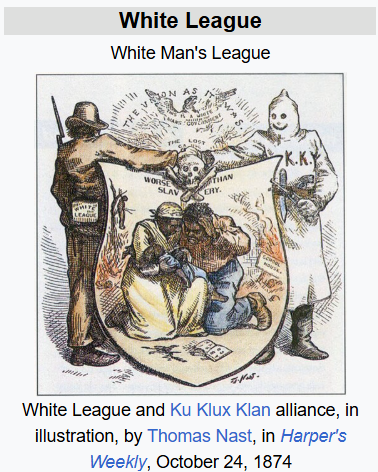
This has happened before—that sick feeling deep in my interior where words do not exist to describe it. Usually, it was caused by something like seeing a bill of sale from one of my enslaver relatives about selling a child. Or buying one. This time it hits closer because I am named for the man about whom I have just learned participated in the White League. The man is my great-grandfather, and he is part of me. In today’s language the White League would be described as a white supremacist quasi-military terrorist organization. It started in 1874 in the South to intimidate freedmen into not voting and prevent the then Republican Party from getting power.
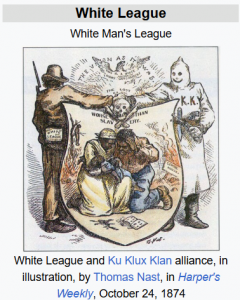 What a shock this morning, Christmas only two days past, to get an email from Ancestry.com with a “hint” about William Marshall Richardson—a newspaper clipping from 1874 about the formation of the white supremacist group in the Louisiana Parish, New Iberia, where he lived. His name was in the list of original members in the article. Articles about the Grande Assemblée de la Ligue Blanche were also printed in Louisiana’s French newspapers.
I thought I knew a lot about my great-grandfather. This latest revelation shocked me. I had heard of the White League but knew almost nothing about it until now.
I am a little older than most of this group, Kids in Birmingham 1963. I moved to Birmingham from a suburb of New York City in 1946 at the age of five. My parents had bought a house on Southside and did not have a car. I was soon taking a city bus downtown by myself for various reasons. On the buses, I noticed the disparity between what white people had to do to ride the bus and what Black people had to do. I learned I was white from riding the buses. They had movable signs inserted in bars across the backs of the seats that said White on one side and Colored on the other, and I knew I was to sit in the white section. I had known about the maternal side of my family being enslavers for as long as I can remember, it always troubled me. After graduating from Ramsay High School and attending St. John’s College in Annapolis, Maryland, for one year, my then-husband and I were married in 1960 in the Unitarian Church. He and his family had been attending the church since the late 1950s. We along with other members of the church soon became involved with the African Americans’ brave struggle for their civil rights.
The year 1963 is seared into everyone’s memory.




 What a shock this morning, Christmas only two days past, to get an email from Ancestry.com with a “hint” about William Marshall Richardson—a newspaper clipping from 1874 about the formation of the white supremacist group in the Louisiana Parish, New Iberia, where he lived. His name was in the list of original members in the article. Articles about the Grande Assemblée de la Ligue Blanche were also printed in Louisiana’s French newspapers.