


Integrationist, Obstructionist, Communist Minister: Reverend Edward V. Ramage, D.D.

By Katherine Ramage, Ph.D.
Told here is a nuanced account of the little-known actions and convictions of my father, Rev. Dr. Edward V. Ramage, who took a leadership role in the civil rights movement in Birmingham, Alabama, in the early 1960s. It examines primary source material from the time – “An Appeal for Law and Order and Common Sense,” “A Call for Unity,” and the “Letter from the Birmingham Jail” – as well as the dates and sequence of events and key political circumstances to elucidate the all-important context for interpreting the actions and perspectives of a local white minister, Rev. E.V. Ramage, and a brilliant national strategist and outsider, Rev. M.L. King.
They were both good men of leadership who were guided by different perspectives and purposes in the same city at the same time, both acting in favor of a common goal. But one held a local perspective while the other had a national view. The primary purpose of my account is to clarify and make known the convictions and contributions of my father to the modern civil rights movement and to create an image of him as contributor rather than an obstructionist. I suggest “An Appeal for Law and Order and Common Sense,” “A Call for Unity,” and the “Letter from the Birmingham Jail” as companion pieces to this one.
This brief account is a long overdue supplement to the historical record. It provides insight into the little known actions and convictions of Reverend Dr. Edward V. Ramage, who, following his conscience and beliefs, took a leadership role in the civil rights movement in Birmingham, Alabama in the early 1960’s. This narrative presents a nuanced picture of the local context and the social and political complexities of the time to elucidate Dr. Ramage’s actions and correct misinterpretations of them.
The dramatic events discussed below did not mark the beginning of Dr. Ramage’s work against racial injustice. He was engaged in citywide leadership on racial issues starting in 1961. However, the published proclamations explained below brought attention to his convictions and work, and increased risks for him and for his family. As a public voice within the Birmingham context, he was risking his ministry and his life, with the KKK monitoring and reacting violently to pro-integration activity.
Rev. Dr. Martin Luther King’s “Letter from the Birmingham Jail”¹ was addressed to the eight white clergy who signed “A Call for Unity,”² published in the Birmingham News on April 12 , 1963 as an open letter to the residents of Birmingham. The date of record for Dr. King’s “Letter” is April 16, 1963. It was framed as a response to the clergy’s “Call for Unity.” Dr. Ramage (the author’s father) was one of the eight signatories of the “Call for Unity” and thereby one of the addressees of the “Letter from the Birmingham Jail.” Important to understanding the subtleties of this essay is that the “Letter” was written in the form of a letter, but King’s intent was for it to be published nationwide to heighten attention to the civil rights movement and to the conditions of racial injustice in Birmingham and nationwide. Contrarily, the clergy were addressing the residents of Birmingham in their Call for Unity. The clergy addressed in the “Letter from the Birmingham Jail” never received a personalized copy from Dr. King. My father likely first saw the mimeographed copies circulated in Birmingham.
Understanding the different perspectives of two good men, Dr. King and Dr. Ramage, is the key to grasping the core nuances of this story — the perspectives of those within, meaning residents of Birmingham concerned with violence on the streets, and the perspective of those looking in from outside, wishing to draw national attention to the movement for racial justice. This story illuminates the complexities and delicacy of this time of change and the very short time frame of events covered here. One actor is the charismatic national moral leader and brilliant strategist Rev. King, and the other, my father, Rev. Ramage, a local religious leader with strong convictions, who was mischaracterized based on lack of understanding of his motives and no examination of his actions.
Frightening Times in Birmingham — 1963
George Wallace was inaugurated as governor of Alabama on January 14, 1963. Wallace was a staunch segregationist, meaning racist, at the time. In response to Wallace’s inauguration, Dr. Ramage and ten rabbis, bishops, and other clerical leaders in Birmingham published on January 16 “An Appeal for Law and Order and Common Sense”³ (dubbed “The White Ministers’ Law and Order Statement”), which appeared in the Birmingham News. The essence of this statement was a public call for respect for new federal laws soon to take effect that would mandate desegregating schools and colleges. It stated: “…defiance is neither the right answer or the solution… no person’s freedom is safe unless every person’s freedom is protected.” George Wallace went on to enshrine himself in history when six months later he stood in the doorway of the University of Alabama to block Black students from enrolling, issuing his infamous defiant vow, “Segregation now, segregation tomorrow, segregation forever.” The clergymen’s Appeal for Law and Order was sadly prescient.
The Appeal for Law and Order, which appeared in the Birmingham News four months before A Call for Unity, lays out the resolve of the signatories to be voices of leadership in that tumultuous time:
We the undersigned clergymen have been chosen to carry heavy responsibility in our religious groups. We speak in a spirit of humility, and only for ourselves. We do not pretend to know all the answers, for the issues are not simple. Nevertheless, we believe our people expect and deserve leadership from us, and we speak with firm conviction for we do know the ultimate spirit in which all problems of human relations must be solved.
In the spring of 1963, Birmingham was a cauldron of tension and instability. Bull Connor, the city’s Commissioner of Public Safety, had lost his bid to become mayor of the city in the April 2 run-off election. The newly elected Mayor Boutwell had taken office in early May when the court ruled that the outcome of the run-off election was legitimate. Though Connor would remain as Commissioner until late May when the Alabama Supreme Court ordered all commissioners to vacate their offices.
Bull Connor was not even a high school graduate and was in cahoots with the Klan. He was a violent, mean-spirited segregationist, so any undesired activity on the streets put Blacks at risk of bodily harm and even loss of life. Following the election, fear ran deep, with two governments at the helm simultaneously – the newly elected Mayor Boutwell and Bull Connor still reigning as the Commissioner of Public Safety — and the Klan actively engaging in threats and violence against Blacks and others known to favor integration.
The Reverend Dr. King Arrives, Clergy Group Issues “Call For Unity”
Dr. King entered this turmoil bringing Southern Christian Leadership Conference (SCLC) support to Fred Shuttleworth’s local movement, the Alabama Christian Movement for Human Rights. King arrived in Birmingham on the day of the run-off mayoral election when Boutwell defeated Bull Connor. Ten days later, on Good Friday, April 12, Dr. King launched his civil disobedience demonstrations, along with about 50 other marchers, defying a recent circuit court injunction that prohibited public gatherings in Birmingham without a permit. Connor had King arrested and placed in solitary confinement in the Birmingham jail, where he set to work on his famous Letter in response to the clergy’s Call for Unity which he saw in a smuggled-in copy of the Birmingham News. Dr. King’s team, including his New York lawyer, Clarence Jones, smuggled in contributions to the letter and smuggled out drafted pieces.
In response to Dr. King’s intention to march in defiance of the recent permit ordinance, fearing what might transpire on the streets with Connor still the Commissioner of Public Safety, the alarmed clergy leadership group issued their second public statement – the previously-mentioned “Call for Unity” (aka “The Good Friday Letter”). A Call for Unity was published in the Birmingham News on the same day that King marched and was arrested, April 12, 1963. Given its profound symbolism for Christians – the day Jesus Christ was crucified and died – Dr. King’s choice of Good Friday for a launch day was clearly a powerful tactic.
The timeline below lays out the chronology of these events.
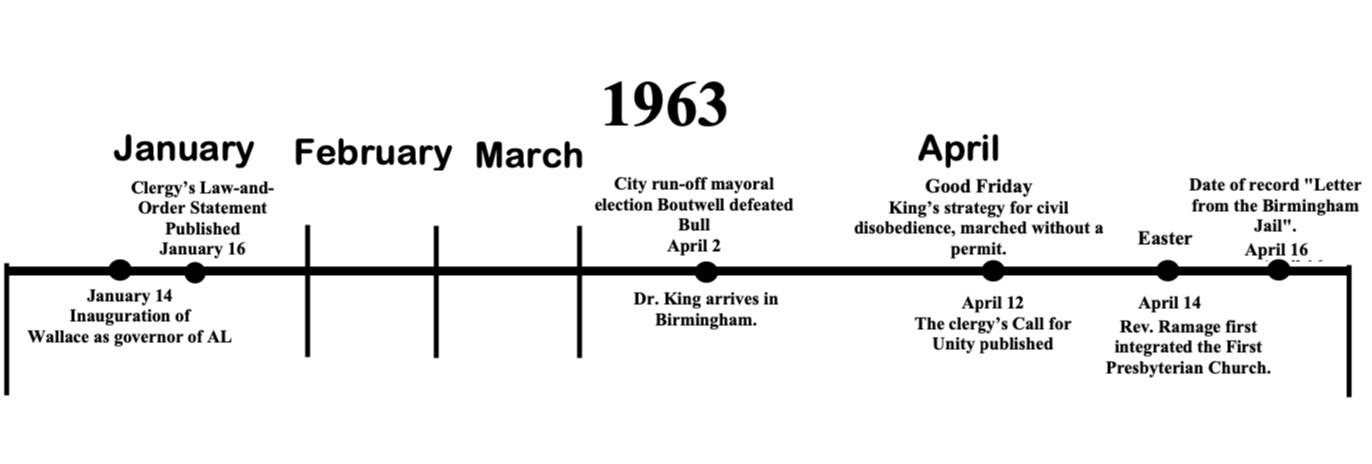
The conditions described above – the new mayor not yet sworn in, Bull Connor still acting as Commissioner of Public Safety, the KKK menacingly active, Dr. King taking marchers to the streets to defy the new ordinance – are rarely mentioned as the context and stimuli for A Call for Unity. It said in part,
We are confronted by a series of demonstrations by some of our Negro citizens, directed and led in part by outsiders. We recognize the natural impatience of people who feel that their hopes are slow in being realized. But we are convinced that these demonstrations are unwise and untimely.
We agree rather with certain local Negro leadership which has called for honest and open negotiation of racial issues in our area. And we believe this kind of facing of issues can best be accomplished by citizens of our own metropolitan area, white and Negro, meeting with their knowledge and experience of the local situation…
Leaders on both sides of the racial line, residents of Birmingham who lived their daily lives within this context, wanted to avoid violence, which they feared would erupt from the city’s (Connor) and state’s (Wallace) officials. They were greatly concerned about how ongoing demonstrations would be handled and were worried for bodily harm to demonstrators. The fear of loss of lives was central to their Unity appeal given this civic strife. They knew Connor would be out of office in a few weeks, hence the plea for time expressed in A Call for Unity. Connor was in a surly mood after losing his mayoral race and facing the imminent loss of his power and status as Commissioner. An interpretation of the Call’s message which differs from King’s stance in the Letter is that the clergy were implicitly pleading with Dr. King not to provoke Connor, to hold off on the streets till he was gone.
Of course for Dr. King, Bull Connor was a perfect foil. And as it happened, the clergy’s fears were hellishly acted out on the streets in downtown Birmingham in early May when Connor released fire hoses and police dogs on demonstrating youth. This competing interests of sincerely moral leaders is rarely identified in discussions of the now-iconic “Letter from the Birmingham Jail.”
Dr. Ramage and the other leading clergy had no road map and erred along the way, but in hindsight much of their work benefited the movement. Nevertheless, one must acknowledge that strands of their Call for Unity are faulty. A Call does not reflect awareness of how unjust laws created the desperate imperative for change, nor awareness of the goals of the civil rights movement, suggesting that “racial matters could properly be pursued in the courts.” Alabama courts did not protect African Americans. A Call for Unity also emphasized keeping decision-making local and in the hands of locals. Bull Connor was local and George Wallace was Alabama’s new governor. These men did not instill faith that progress could be made in local negotiations or collaborations.
Nonetheless some leaders of both races were against the demonstrations. It was not a clear Black versus white breakdown. The “moderates” of both races were trying to find a just path forward. Some Black community members and leaders, such as Emory O. Jackson, editor of Birmingham World, a twice-weekly African American newspaper, shared the perspective that direct action demonstrations were not the best strategy for addressing racial segregation and discrimination. These residents of Birmingham worried that national and international attention would inhibit what they viewed as the need for critical discussion between local whites and Blacks. Communication between people of different races and creeds does indeed build understanding. Dr. Ramage’s perspective was shaped within the city and focused on the city in which he resided. A city in turmoil where the staunchly white supremacist city government was in transition, and uncompromising, as personified by Bull Connor, who was capable of violence. Dr. Ramage and other civic leaders were striving to find the right pitch in this charged racial cacophony but history affirms Rev. Fred Shuttlesworth’s and King’s more far-reaching actions.
Reverend King Writes a Letter in Jail
Dr. King, an extraordinary moral leader and strategist yet not a resident of Birmingham, conceived his Letter as a key element of his national campaign for support, raised awareness, and change. He had a different purpose than the local religious leaders and expressed a different perspective. The concept of relegating the movement for change to local control was exactly what he and others opposed, born out of bitter experience and history. They believed that national attention was necessary — attention from people who were not blinded by the culture of Alabama — to break the stranglehold of institutionalized racism towards African Americans in Birmingham, in Alabama, and elsewhere in the country. King expressed his perspective in the Letter:
Never again can we afford to live with the narrow, provincial ‘outside agitator’ idea. Anyone who lives inside the United States can never be considered an outsider anywhere in this country.
The Letter from the Birmingham Jail, written in response to A Call for Unity, did indeed capture the eyes and hearts of the nation. Millions know the Letter and may believe it was addressed to eight misguided, craven clergymen, of whom Dr. Ramage was one. The eight clergy have largely been ignored in the historical narrative of the “Year of Birmingham” except to be vilified as the addressees of the Letter from the Birmingham Jail. They have been cast as racists, or as moderate obstructionists, as the Letter from the Birmingham Jail implied:
I must confess that over the last few years I have been gravely disappointed with the white moderate. I have almost reached the regrettable conclusion that the Negro’s great stumbling block in the stride toward freedom is not the White Citizen’s Counciler or the Ku Klux Klanner, but the white moderate who is more devoted to “order” than to justice…Shallow understanding from people of goodwill is more frustrating than absolute misunderstanding from people of ill will. Lukewarm acceptance is much more bewildering than outright rejection.
As the timeline shows, the date of the mayoral run-off election (Connor’s loss) and Dr. King’s arrival coincided on April 2, 1963, the clergy’s Call for Unity and Dr. King’s march were ten days later, both on April 12, 1963, and the date of record of the “Letter from the Birmingham Jail” was four days after that, on April 16, 1963. It was fast-paced, and more was to happen on Easter Sunday, April 14.
Reverend Ramage Takes the Moral Action, Integrates First Presbyterian
Little is known about Dr. Ramage’s work in Birmingham, yet Dr. King’s revered Letter has led to misunderstandings of his convictions and actions. Deep within the Jail Letter Dr. King commends one of the signatories of A Call for Unity, Rev. Earl Stallings, for welcoming “Negroes to your worship service on a non-segregated basis.” This Stallings event occurred on Palm Sunday, April 7, one week before the Jail Letter was circulated in Birmingham. Two days before the Letter was made public, Easter Sunday, April 14, having prepared for covert information that African Americans would visit white churches, Rev. Ramage insisted that the doors of the First Presbyterian Church he served be opened to all who desired to worship there, taking a stance opposed by many of his longtime supporters and church leaders. Two young African American women came down the center aisle and worshipped at his church that day. Rev. Ramage had asked one of his dear friends to sit near the front of the church to welcome the young women into his pew. Rev. Ramage greeted the young women after the service and saw that they were safely on their way. This was the first time the First Presbyterian Church of Birmingham was integrated. Unlike Stallings, Rev. Ramage received no public acknowledgement for taking what the Letter calls a “Christian stand.”
The author witnessed this historic event as a 12-year-old from the back balcony of “First Pres,” where she and her best friend sat that day as they did every Sunday. (See Katherine Ramage’s firsthand account, here.) She witnessed some congregants leave that Easter Sunday by the side aisles in protest as the African American young women walked down the main aisle to sit on the second row. As the clergymen had cautioned, it was a fraught time.
The young women who crossed the racial barrier and worshipped at the First Presbyterian Church on Easter Sunday and subsequent Sundays, as others at Rev. Stalling’s church had, were participants in a strategy by Dr. King’s Southern Christian Leadership Conference to confront segregation by having Black visitors attend worship services at white churches. Some churches blocked their doors to prevent those visitors from entering. Revs. Ramage and Stallings opened the doors of their churches to African Americans on Easter Sunday and thereafter.
A Heavy Price
Dr. Ramage stood firmly behind his commitment to integrate the church even though he did not have full support of the church’s governing body, called the “session.” He told the session, “We are committed to open the doors of worship to all who come.” As a result of his convictions and actions, he received death threats from groups such as the White Citizens Council and the KKK and was labeled a “Communist” by segregationist members of his own congregation. Black sympathizers in their minds were “Communists.” (This notion reached back to years past when Communist Party members worked to unionize Black steelworkers, who faced powerful discrimination in the types of jobs they could hold and the treatment they received from steel mill management.) The segregationists in the First Presbyterian congregation factionalized and formed a committee to purge the church of Communists. Top on their agenda was to get rid of the Rev. Dr. Ramage, their “Communist integrationist” pastor.
Despite his work in support of racial justice, Dr. Ramage was labeled a racist by those who viewed the ministers’ efforts as stated in the April 12 Call for Unity as obstructing the civil rights movement. At the same time, he was labeled a Communist and integrationist, both with negative connotations, for his willingness to integrate the First Presbyterian Church and to work more broadly for improved race relations. Dr. Ramage risked losing his church and his life for the stance he took on race. As a Presbyterian minister, he did not have the protection and support of a church hierarchy. (The Presbyterian Church U.S. has a “representative” form of church government, meaning that local church elders elected by the congregation lead and govern each individual church, resulting in the absence of larger institutional protection.)
No doubt the authors of the Letter did not have the Rev. Dr. E.V. Ramage in mind when they wrote these words, but this passage describes him precisely. He was there, by his own lights and determination.
But again I am thankful to God that some noble souls from the ranks of organized religion have broken loose from the paralyzing chains of conformity and joined us as active partners in the struggle for freedom…Some [religious leaders] have been kicked out of their churches, and lost support of their bishops and fellow ministers. But they have gone with the faith that right defeated is stronger than evil triumphant. These men have been the leaven in the lump of the race. Their witness has been the spiritual salt that has preserved the true meaning of the gospel in these troubled times. They have carved a tunnel of hope through the mountain of disappointment.
After months of threats against him and his family (wife and five children) – including slashed tires, tire-blowing nails in the driveway, oil slicks, midnight threats to his family and more – Rev. Ramage was driven from Birmingham. He left to take a pulpit in Houston, Texas, in late 1963, and to face a deep crisis of faith that gripped him for years.
References
1 – https://library.samford.edu/special/treasures/2013/graphics/SC4630wm.pdf
2 – https://www.dbu.edu/mitchell/modern-resources/_documents/acallforunitytextandbackground.pdf
3 – https://historyscoop.wordpress.com/2016/11/30/an-appeal-for-law-and-order-andcommon-sense-january-16-1965/
Books and articles for reference
Jonathan Bass’s Blessed Are the Peacemakers: Martin Luther King, Jr., Eight White Religious Leaders, and the” Letter from the Birmingham Jail,” Louisiana State University Press, 2001.
Randall C. Jimerson’s Shattered Glass in Birmingham: My Family’s Fight for Civil Rights 1961-1964, Louisiana State University Press, 2014.
“Emory O. Jackson, the Birmingham World, and the Fight for Civil Rights in Alabama,” Black Past, June 21, 2016, here
Katherine Ramage, Ph.D., wrote this original essay, giving permission to Kids in Birmingham 1963 to publish it in December 2025. This piece complements the personal story she published on the KIDS website in 2013, here.