


The White League and My Great-Grandfather
This has happened before—that sick feeling deep in my interior where words do not exist to describe it. Usually, it was caused by something like seeing a bill of sale from one of my enslaver relatives about selling a child. Or buying one. This time it hits closer because I am named for the man about whom I have just learned participated in the White League. The man is my great-grandfather, and he is part of me. In today’s language the White League would be described as a white supremacist quasi-military terrorist organization. It started in 1874 in the South to intimidate freedmen into not voting and prevent the then Republican Party from getting power.
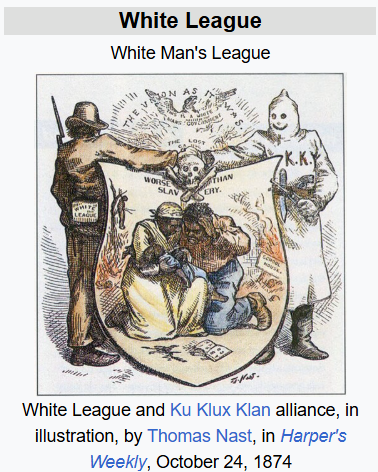 What a shock this morning, Christmas only two days past, to get an email from Ancestry.com with a “hint” about William Marshall Richardson—a newspaper clipping from 1874 about the formation of the white supremacist group in the Louisiana Parish, New Iberia, where he lived. His name was in the list of original members in the article. Articles about the Grande Assemblée de la Ligue Blanche were also printed in Louisiana’s French newspapers.
I thought I knew a lot about my great-grandfather. This latest revelation shocked me. I had heard of the White League but knew almost nothing about it until now. (more…)
Birmingham: Trauma and Sorrow
I am a little older than most of this group, Kids in Birmingham 1963. I moved to Birmingham from a suburb of New York City in 1946 at the age of five. My parents had bought a house on Southside and did not have a car. I was soon taking a city bus downtown by myself for various reasons. On the buses, I noticed the disparity between what white people had to do to ride the bus and what Black people had to do. I learned I was white from riding the buses. They had movable signs inserted in bars across the backs of the seats that said White on one side and Colored on the other, and I knew I was to sit in the white section. I had known about the maternal side of my family being enslavers for as long as I can remember, it always troubled me. After graduating from Ramsay High School and attending St. John’s College in Annapolis, Maryland, for one year, my then-husband and I were married in 1960 in the Unitarian Church. He and his family had been attending the church since the late 1950s. We along with other members of the church soon became involved with the African Americans’ brave struggle for their civil rights.
The year 1963 is seared into everyone’s memory. (more…)
We were saved for a purpose: To tell our story
In March 2025, Floyd Armstrong gave Kids in Birmingham 1963 an oral history interview about growing up in Birmingham, Alabama in “a civil rights family.” As the sons of a barber who was “committed to the struggle,” Floyd and his brother Dwight, as elementary school-age children, marched in the Birmingham Children’s Crusade and were jailed for several days in May 1963. That September, the Armstrong brothers were the first Blacks to integrate an all-white school in the city of Birmingham—Graymont Elementary School. They knew the civil rights leaders personally, including Rev. Fred Shuttlesworth and the NAACP lawyers who prepared them for the challenges they faced at that school. Just a few days after their historic action, on September 15, 1963, Klan members bombed the Sixteenth Street Baptist Church, killing four young girls and sparking whites to murder two young African American boys. Floyd is certain, he says, that the violence was meant for his family, but that, “We were saved for a purpose: To tell our story.” (more…)
I can still see that moment, 63 years later
One day of 1963 that stands out for me is the moment I heard that 4 girls were blown up in the 16th Street Baptist Church. I knew one of them. We attended the Friendship and Action events together – in a group formed to bring together Black and white families in spite of Jim Crow segregation.
I can still see that moment, 63 years later. I was standing in front of our dining room table, staring out the window into our backyard. This was the table I slept under with a pillow on top of me so that if any of the bomb threats my family was receiving actually materialized, I wouldn’t be impaled by the glass from that window.
I live with survivor’s guilt. (more…)
They bombed our home, but we persisted
August 20, 1963, my mother and I went to the movie theater as we always did before I returned to college. Halfway through the film, a neighbor came to tell us that our house had been bombed. My heart was racing. I was filled with anxiety, fear, and anger. As we approached our house, outraged Blacks filled Center Street North. Police tried to control the crowd by firing guns is in the air. Windows had been blown out, drapes shredded, the garage doors destroyed. My dog Tasso had been killed in the bombing. I couldn’t stop crying. I grieved Tasso’s death for a long time. (more…)