


What was going on?
It was 1963. I was 10 years old. I was in the 5th grade and looking forward to the day. My Mom was taking me downtown, on the bus, for a Dr.’s appointment. I was excited because she had promised me a visit to the lunch counter at FW Woolworths for a chocolate milkshake.
All I can remember is that we were leaving the store to catch our bus home. We came out onto the street and there was a large crowd. All ages, mostly black, children and adults, yelling and screaming and crying. (more…)
All fired up and ready to participate again
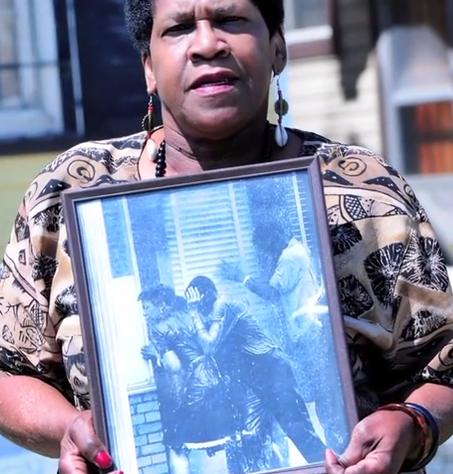 My name is Mamie King-Chalmers and this is my photo. I was one of the young adults that fought in Birmingham, Alabama, in 1963. That photo is important to me because it shows my participation in the civil rights struggle and it’s a legacy for my children and my grandchildren to carry on.
During those times I had faith, courage, and I was willing to do anything to help with the conditions that was being brought upon us in the South. My whole family was involved in the civil rights struggle. My father said, “We’re going down and get involved.” That’s what I believed in and that’s what I did, and that’s what I will continue to do. (more…)
Arizona
Author’s note: I’ve used the old-fashioned, at-the-time-polite terms “Negro” and “colored” to describe the African Americans who appear in these stories. I hope you will understand I have no intention to offend anyone by my choice of those terms. For integrity’s sake, I’m merely using the vernacular of the time. (From The Newspaper Boy by Chervis Isom, 2013, page xiii)
He pointed to large, raised letters near the end of the dusty eight inch steel pipe. With one swipe, I brushed them clean. “Made in Belgium,” I muttered, as if he needed my translation. Then he stalked away. I studied the dozens of identical pipe stacked in the yard. The electric grinder he had given me, now hanging from my hand, seemed wholly inadequate for the job I had been told to do.
As I dithered, trying to figure out the best way to begin, I noticed the colored guy—they called him Arizona—watching me. His neutral face showed no emotion, but I knew he must have been amused to watch a college boy flounder in ignorance and incompetence.
How do I begin? I wondered. Is there a place to sit? If I sit on the pipe, will it roll? There must be a trick to this somehow. Arizona watched quietly. After a few moments, I looked at him. “You done this before?” (more…)
Born with Brown v. Board of Education decision
On the day that I was born on May 18, 1954 in Birmingham, Alabama, the newspaper headlines around the country announced that the Supreme Court of the United States had outlawed public school segregation in the case entitled Brown versus Board of Education. Relatives used to tease me and say that when my mother, Quintella Dobbins Horne, a high school teacher, heard that the schools were going to be desegregated, she went into labor. However in 1963, nine years after that decision, after having skipped the second grade, I was in the fourth grade at all-Black Center Street Elementary School.
Until I was approximately eight years old, our family attended Westminster Presbyterian Church. It was pastored by Rev. John W. Rice who was the father of Condoleezza Rice. Condoleezza and I, only a few months apart in age, were in the same Sunday School class. Mrs. Rice was a music teacher and Condoleezza began playing the piano at a very early age. Soon the mothers of other young girls in the neighborhood decided that we should take piano lessons as well, whether we wanted to or not. My Mom also made sure that my younger sister Janet and I took ballet and tap dance lessons. (more…)
“In Ourselves Our Future Lies”
Just three and a half years after surviving my unhappiest year, 1963, the Birmingham News interviewed four young adults to speak about changes in the New South. In its May 21, 1967 edition, while a student at Miles College, I was recorded saying, “the South is improving, but you learn that you must struggle to achieve something. You learn that nothing really comes easy.”
Indeed, life during the fall of 1963 was far from easy in one old, hateful southern city: Birmingham, Alabama. I was a senior at Ullman High School eagerly awaiting graduation in its winter class. Cynthia Wesley was a fourteen-year-old student at Ullman; I was two years older. We first exchanged flirting glances. Then, through our friends, we passed little innocent notes to each other. After these notes, our friendship blossomed. She was so smart, happy, and full of hope. I still remember her smile that melted away all my shy defenses. (more…)