


Worlds Apart: Growing Up in a Bubble in Birmingham
A large Confederate flag filled most of one wall of my grandfather’s study in his Birmingham home during the 1950s and 1960s. It was always the first thing I noticed when I walked into the dimly lit room—a startling shout of hot red and star-studded blue against a dark stone wall.
On the opposite wall was a painting of the Princess Pocahontas, who, according to genealogical research by my great-grandmother, was said to be our direct ancestor. I heard once that my grandfather, proud of being related to royalty but uncomfortable with the darkness of the princess’s complexion, had Pocahontas’s skin lightened a bit before he hung the painting.
My grandmother used to take me with her to the grocery store in her old Dodge. When I was about six years old, I remember getting into her car one day and asking her the name of a Black lady we had seen earlier that day. She quickly reprimanded me, “Pam, you never call a colored woman a ‘lady.’” Actually, she probably didn’t say “colored woman,” but something else. I remember feeling smacked down by the reprimand. And I was careful not to repeat that grave breach of etiquette in the following years. (more…)
One Sunday morning, September 15, 1963
September 15, 1963, was the day I was to move into a room near Birmingham Southern College where I was just starting my sophomore year. My family, who had been very active in the Civil Rights Movement for a number of years, lived in Homewood and we were listening to the radio as we packed up the car with my clothes, books and other things that I would be needing that semester. I was to be rooming that year at the home of one of the BSC art professors with Sena Jeter Naslund, who was later to write the novel Four Spirits about that time and that day.
We were devastated when we got the news of the church bombing and the four children who were killed. The McNairs, one of the families whose daughter was killed that day, were friends of my parents. Although Birmingham Southern was still a “whites only” school at that time, there was a small group of students and professors who supported the Movement and were very engaged. We frequently visited with students and professors at Miles College, the all Black school near BSC. The church bombing was all anyone could talk about for days and, of course, we went to the funeral service at which Martin Luther King spoke. There was an overflow crowd there that day but we managed to get into the top balcony of the church, from which we could hear, but not see, the service below. (more…)
A City, a Mountain, and a Tiny Kingdom
Margaret Brown lived in Titusville, a neighborhood in Birmingham. Two months before I was born in 1949, she was hired to come and live with my family, and work in our home six days a week as a maid, or “the help,” as folks in Mountain Brook would have said back then. I would imagine that Margaret had dreams like any other young woman: a husband, a family of her own, perhaps. She probably knew she was abandoning those dreams when she took the offer to come cook, clean, and do the laundry for my family. I can only imagine what Margaret was thinking when she boarded the #50 Crestline bus in downtown Birmingham, leaving her world and heading for “The Tiny Kingdom.” (more…)
What was going on?
It was 1963. I was 10 years old. I was in the 5th grade and looking forward to the day. My Mom was taking me downtown, on the bus, for a Dr.’s appointment. I was excited because she had promised me a visit to the lunch counter at FW Woolworths for a chocolate milkshake.
All I can remember is that we were leaving the store to catch our bus home. We came out onto the street and there was a large crowd. All ages, mostly black, children and adults, yelling and screaming and crying. (more…)
All fired up and ready to participate again
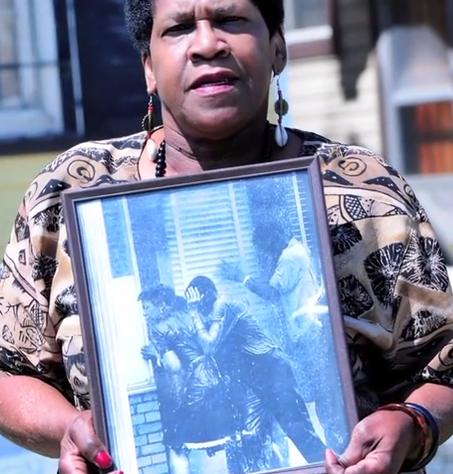 My name is Mamie King-Chalmers and this is my photo. I was one of the young adults that fought in Birmingham, Alabama, in 1963. That photo is important to me because it shows my participation in the civil rights struggle and it’s a legacy for my children and my grandchildren to carry on.
During those times I had faith, courage, and I was willing to do anything to help with the conditions that was being brought upon us in the South. My whole family was involved in the civil rights struggle. My father said, “We’re going down and get involved.” That’s what I believed in and that’s what I did, and that’s what I will continue to do. (more…)